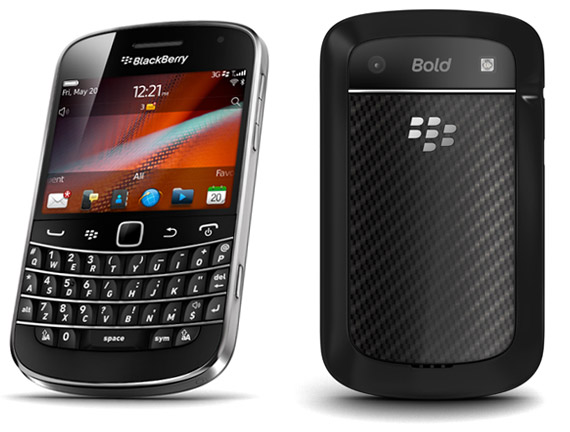
HISTORY
The first BlackBerry device, the 850, was introduced in 1999
as a two-way pager in Munich, Germany. The name BlackBerry was coined by the
marketing company Lexicon Branding.
In 2003, the more commonly known smartphone BlackBerry was
released, which supports push email, mobile telephone, text messaging, Internet
faxing, Web browsing and other wireless information services. It is an example of
a convergent device. The original
BlackBerry devices, the RIM 850 and 857, used the DataTac network.
BlackBerry first made headway in the marketplace by
concentrating on email. RIM currently offers BlackBerry email service to
non-BlackBerry devices, such as the Palm Treo, through its BlackBerry Connect software.
The original BlackBerry device had a monochrome display, but
all current models have color displays. All models, except for the Storm series
and the all-touch Torch 9850/9860 have a built-in QWERTY keyboard, optimized for "thumbing", the use of only the thumbs to type. The Storm 1 and
Storm 2 include a Sure Type keypad for typing.
Originally, system navigation was achieved with the use of a scroll wheel
mounted on the right side of phones prior to the 8700. The track wheel was
replaced by the trackball with the introduction of the Pearl series which
allowed for 4 way scrolling. The trackball was replaced by the optical track
pad with the introduction of the Curve 8500 series. Models made to use iDEN networks
such as Nextel and Mike also incorporate a push-to-talk (PTT) feature, similar to a two-way radio.
OS
The operating system used by BlackBerry devices is a proprietary multitasking
environment developed by RIM. The operating system is designed for use of input
devices such as the track wheel, track ball, and track pad. The OS provides
support for Java MIDP 1.0 and WAP 1.2. Previous versions
allowed wireless synchronization with Microsoft Exchange Server email and calendar, as well as with Lotus Domino email. OS 5.0 provides a subset of MIDP 2.0, and allows
complete wireless activation and synchronization with Exchange email, calendar,
tasks, notes and contacts, and adds support for Novell GroupWise and Lotus Notes. The BlackBerry Curve 9360, BlackBerry Torch 9810, Bold
9900/9930, Curve 9310/9320 and Torch 9850/9860 feature the most recent
BlackBerry OS 7 (as of July 2012).
Third-party developers can write software using these APIs,
and proprietary BlackBerry APIs as well. Any application that makes use of
certain restricted functionality must be digitally signed so that it can be associated to a developer account at RIM.
This signing procedure guarantees the authorship of an application but does not
guarantee the quality or security of the code. RIM provides tools for developing
applications and themes for BlackBerry. Applications and themes can be loaded
onto BlackBerry devices through BlackBerry App World, Over The Air (OTA)
through the BlackBerry mobile browser, or through BlackBerry Desktop Manager.
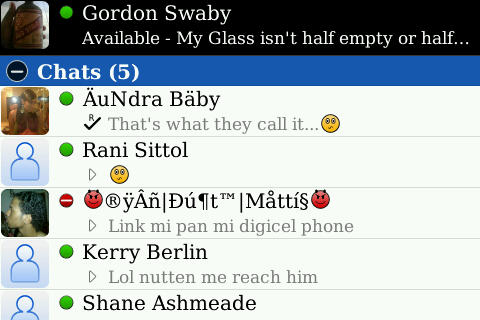
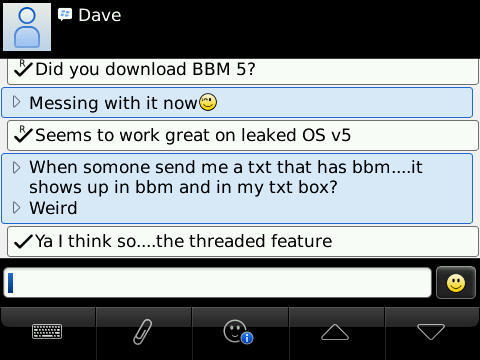
BlackBerry Messenger
 BlackBerry devices use the
proprietary BlackBerry Messenger also known as BBM, software for sending
and receiving encrypted instant messages, voice notes, images and videos
via BlackBerry PIN. As long as your cell phone has a data plan these messages
are all free of charge. Some of the features of BBM include groups, bar-code
scanning, lists, shared calendars, BBM Music and integration with apps and
games using the BBM social platform.
BlackBerry devices use the
proprietary BlackBerry Messenger also known as BBM, software for sending
and receiving encrypted instant messages, voice notes, images and videos
via BlackBerry PIN. As long as your cell phone has a data plan these messages
are all free of charge. Some of the features of BBM include groups, bar-code
scanning, lists, shared calendars, BBM Music and integration with apps and
games using the BBM social platform.
Third-party software
Third-party software available for use
on BlackBerry devices includes full-featured database management systems, which can be used to supportcustomer relationship management clients and other applications that must manage large
volumes of potentially complex data.
In March 2011, RIM announced an
optional Android player that could
play applications developed for the android system would be available for theBlackBerry PlayBook, RIM's first entry in
the tablet market.
On August 24, 2011 Bloomberg News reported unofficial rumors that BlackBerry devices
would be able to run Android applications when RIM brings QNX and the Android
App Player to BlackBerry. On October 20, 2011 RIM officially announced
that Android applications could run, unmodified, on the BlackBerry tablet and
the newest BlackBerry phones, using the newest version of its operating system.
CPU
The latest BlackBerry devices such as
the Bold 9900/9930, Torch 9810, 9850/9860 feature a Qualcomm Snapdragon
MSM8260 CPU clocked at 1.2 GHz. Entry-level models, such as
the Curve 9360, feature a Marvell PXA940 clocked at 800 MHz. Previous
BlackBerry devices, such as the BlackBerry 9000 series, were equipped with
XScale 624 MHz processors. The BlackBerry Curve 8520 featured a
512 MHz processor, while the Bold 9700 featured a newer version of the
Bold 9000's processor, but is clocked at the same speed. Early BlackBerry
devices, such as the BlackBerry 950, used Intel 80386-based processors. BlackBerry 8000
series smartphones, such as the 8700 and the Pearl, are based on the
312 MHz ARM XScale ARMv5TE PXA900. An exception to
this is the BlackBerry 8707 which is based on the 80 MHz Qualcomm 3250
chipset; this was due to the PXA900 chipset not supporting 3G networks. The
80 MHz processor in the BlackBerry 8707 meant the device was often slower
to download and render web pages over 3G than the 8700 was over EDGE networks.